

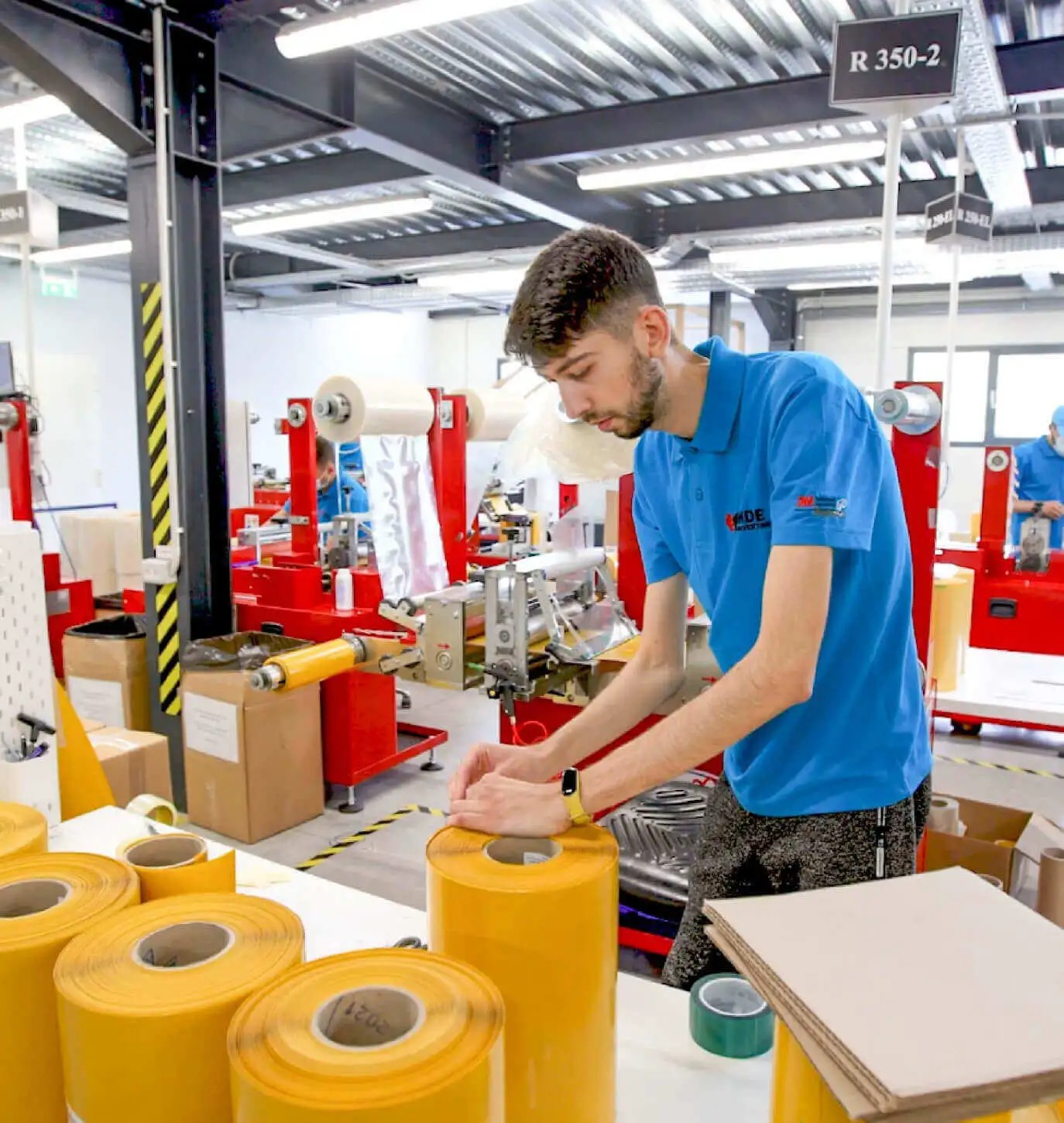
Production efficiency has become one of the main priorities in modern manufacturing. Companies are expected to maintain consistent quality, reduce waste, and keep operations stable even as requirements continue to evolve. In many situations, inefficiencies appear because certain parts of the production process aren’t fully aligned with the actual needs of the application.
Manufacturing environments often involve complex assemblies and strict tolerances. Even small issues may affect speed, stability, or consistency over time. For many companies, it may be a good decision to collaborate with specialists included in the 3M Preferred Converter list. This gives them access to advanced solutions that can solve a lot of problems within their operations.
Reducing inefficiencies usually requires more than improving machinery or increasing production speed. In many cases, it also involves better process compatibility, more precise components, and solutions adapted to the way products are assembled and used. Converted solutions may help simplify operations and improve long-term consistency.
Repetitive problems can reduce efficiency over time
In manufacturing, recurring minor problems often create larger operational difficulties if they aren’t identified and managed correctly. This is why it’s important for manufacturers to analyze multiple technical aspects during development. This may include researching topics such as what is Thinsulate, what solutions are best for vibration damping and so on.
Some common situations that may create recurring production problems include:
- Repeated fitting corrections during assembly
- Inconsistent positioning between elements
- Unnecessary material waste
- Interruptions caused by unstable component handling
- Uneven pressure distribution between surfaces
- Variation between production batches
When ignored or unidentified, these issues can affect production speed, increase operational stability, and create additional costs. Moreover, companies can also experience delays caused by repeated manual adjustments or inconsistent assembly results between cycles.
There are industries such as automotive in which dimensional precision is especially important. Even a small positioning variation may influence how a component fits into the final assembly. Here, professional converters can eliminate variation through customized technical solutions, like a precise fascia car component.
Better process analysis can prevent unnecessary adjustments
Reducing inefficiencies is not only about solving problems after they appear. In many cases, better analysis during the development stage can help prevent repetitive operational difficulties. Early evaluation of technical requirements often allows companies to identify possible limitations and optimize production conditions more efficiently.
Production requirements may vary depending on the application, the assembly process, and the operating environment. Some products are exposed to vibration and movement, while others must function inside compact assemblies where positioning accuracy is critical. Because of this, manufacturers often need solutions configured according to the actual technical and operational conditions.
Before developing a converted component, several aspects are usually evaluated:
| Factor analyzed | Importance |
| Dimensional tolerances | Influence assembly precision and repeatability |
| Assembly method | Affects positioning and integration requirements |
| Type of substrates | Impacts compatibility between surfaces |
| Environmental exposure | May affect long-term component behavior |
| Available installation space | Determines component geometry and dimensions |
Well-configured components can simplify multiple production stages
In many industrial applications, components influence more than a single production step. Depending on the project, the same converted part may help support vibration control, sealing, spacing, or easier assembly integration. Therefore, properly configured technical solutions may contribute to smoother operations across multiple stages of production.
The role of converted adhesive components often extends beyond basic assembly functions. Their geometry, thickness, and material properties may influence how easily parts are positioned or how stable they remain during operation. At the same time, they can influence the integration into automated manufacturing processes.
Here’s what specialized solutions developed by converters can support:
- Reduced need for manual corrections
- Improved contact between surfaces
- Vibration damping between components
- Easier handling during production
- Cleaner integration inside compact assemblies
In many manufacturing environments, reducing unnecessary adjustments is very important for maintaining stable production flow. Components configured according to the real assembly conditions may help operators work more efficiently. They can also help reduce interruptions caused by positioning difficulties or inconsistent handling.
Long-term efficiency depends on adaptable manufacturing solutions
Through adhesive material converting, manufacturers can gain access to components adapted to their specific assembly methods, operating conditions, and production requirements. This helps them maintain stability, reduce inefficiencies, and respond efficiently to changing demands.
As industries continue to evolve, manufacturers increasingly need solutions that can support operational efficiency and long-term process consistency. Personalized technical components play an important role in helping companies simplify their processes and improve reliability over time.

